
Women's Program Custody Status
The Avoyelles Women’s Transitional Work Program is a correctional program, not ordinary community residence. DPS&C lists it separately in the Avoyelles Parish facility directory. APSO also describes a transitional work program for qualifying trustees within local correctional operations. A participant may be allowed to work beyond the secure site while still owing a sentence and remaining subject to custody, movement rules, and return requirements.
Seeing someone at work, hearing that she has an assigned placement, or learning that she travels into the community does not prove release. The event to seek is program completion, discharge from confinement, transfer, or another status recorded by the operator or DPS&C. If supervision follows, release from confinement still may not be full discharge. Use the exact agency phrase and effective date.
Women's Program Release Outcomes
A woman can leave the Avoyelles program through more than one route. Successful completion may coincide with release from confinement, but it may also lead into parole, good-time supervision, probation, or another correctional placement. An administrative move to DC-3 or a state women’s institution is a transfer. A court order, sentence calculation, detainer, or new case can also shape the result.
| Program event | Custody meaning |
|---|---|
| Outside work assignment | Participant remains in correctional custody. |
| Program completion | Milestone that still requires confirmation of the next legal status. |
| Community release | Confinement ends, possibly followed by supervision. |
| Transfer or return | Custody continues at DC-3, a state facility, or another location. |
A detainer also needs care. It asks a local agency for notice and may permit limited added detention so another authority can assume custody. The request does not itself prove pickup. Ask which agency actually received the person. If ICE took custody, its locator covers current detainees and people released from ICE custody within the last 60 days, not a permanent history. Ordinary Avoyelles work-program cases should not be routed to ICE without a documented detainer or transfer.
Check a Women's Program Release
Because the operator is described as APSO and the program is also listed by Louisiana DPS&C, begin by identifying the sentence and record custodian. A parish detainee’s local event may appear through Avoyelles LAVNS and APSO records. A woman serving a DPS&C sentence needs the statewide LAVNS/VINELink and department record route. Do not assume the current parish roster preserves a former participant after discharge.
- Call the program number and ask whether the person was assigned to the Avoyelles Women’s Transitional Work Program under APSO or a DPS&C sentence.
- Search the official Avoyelles roster for current parish custody and the Louisiana LAVNS/VINELink portal for a state correctional record.
- Match the full name, date of birth, identification number, location, and responsible agency before accepting a result.
- Ask the operator for the effective date and whether the event was outside work, program completion, community release, supervision, return, or transfer.
- Request the release or discharge record from the agency that held legal custody when online status is unclear.
DPS&C says its public locator information is updated every 24 hours. The parish roster has shown a roughly half-hour observed refresh, though APSO does not guarantee it. Neither timing statement changes the core rule: online absence is not a release certificate. A spelling mismatch, source delay, or move between facilities can also produce no match. The Avoyelles Parish release search provides the wider records-request and court-confirmation route.
Women's Program Release Contact
DPS&C’s parish directory publishes the program at 640 Choupique Lane with P.O. Box 340. The contact number is also used for the nearby women’s correctional operation. State the full program name when calling. No official public source in the research provides release hours, an exit point, property pickup rules, a visitor waiting area, or transportation instructions. Confirm all logistics directly before travel.
Avoyelles Women’s Transitional Work Program640 Choupique Lane
P.O. Box 340
Cottonport, LA 71327
Phone: 318-876-2871
Listed by Louisiana DPS&C
For an APSO-held record, the sheriff’s records contact can be reached at 675 Government Street, Marksville, LA 71351; 318-253-4000; or info@avoyellesso.org. Administrative hours are Monday through Friday, 8 a.m. to 4 p.m., excluding holidays. APSO posts no special release-record form or public fee schedule on the pages reviewed. Use a clear letter or email and request a written cost estimate.
For a DPS&C sentence, use the department locator at 225-383-4580 and the time-computation line at 225-342-0799 when relevant. Direct a public records request to DPS&C for the specified public fields, including discharge date. Do not ask the local program to certify an entire statewide sentence history that the department controls.
Avoyelles Women's Program Listing
The DPS&C Avoyelles Parish directory gives the transitional work program its own listing. That separate entry supports treating it as a distinct facility page even though it is associated geographically with the women’s correctional site. The directory does not provide a capacity figure or a live participant count, so none should be inferred.
View the official parish facility directory source for the program name, address, and telephone number.
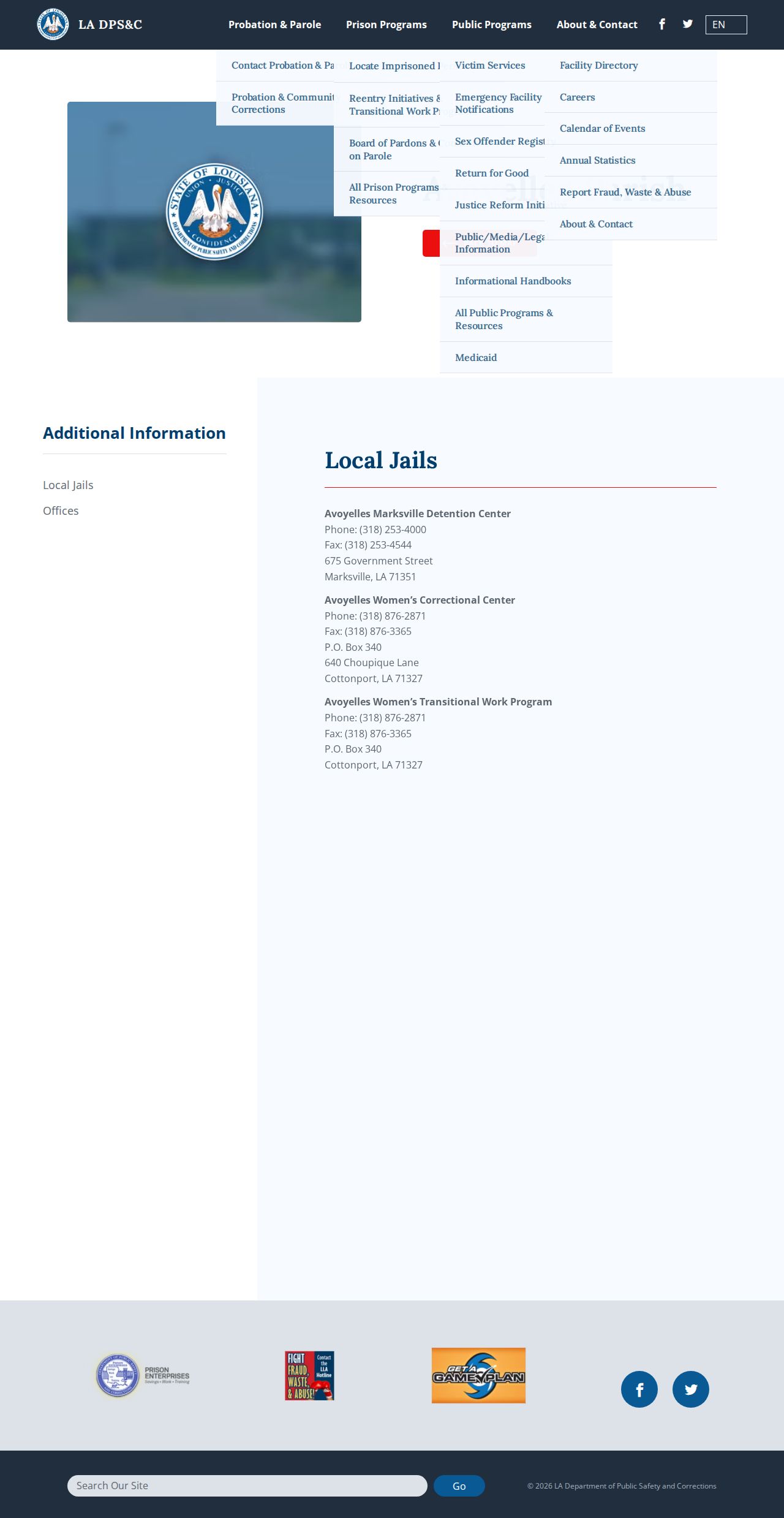
The source capture distinguishes the women’s transitional program within the parish facility directory. It establishes contact details, not the release status of a participant.
Women's Program Release Record
A useful request names the person, date of birth or other known identifier, approximate admission period, and the full program name. Ask for the admission date, program assignment dates, release or discharge date and time, legal authority or status, and public receiving agency if she transferred. If the woman was working outside, ask whether she remained housed or legally confined at that time. This separates routine program movement from an actual custody change.
- Work release
- Approved work outside the secure setting while correctional custody continues.
- Completion
- A program milestone that does not by itself define the next legal status.
- Parole
- Release from imprisonment under DPS&C community supervision.
- Probation
- Court-ordered supervision, often imposed as part of a sentence rather than release by a parole board.
- Discharge
- The end of the relevant correctional custody or supervision term.
Louisiana R.S. 15:714 expressly includes a person confined in a work-release facility or under probation or parole. The record subject may request a letter documenting confinement or supervision from the institution or local DPS&C Probation and Parole office. The letter must include her name, confinement or supervision dates, admit date, release date, and last incarceration location. It must issue no later than seven days after receipt.
That letter is especially useful when outside work creates confusion about when custody truly ended. It belongs to the person described by the statute and is not an unrestricted public-person lookup. A separate public request must follow the public-record rules and confidentiality limits of the actual custodian.
Cottonport Facility Identity Trap
Avoyelles has two parish detention centers, a state prison formerly called Avoyelles Correctional Center, and this women’s program. The names and addresses are close enough to cause bad routing. APSO lists female DC-3 at 641 Choupique Lane. DPS&C lists the transitional program at 640 Choupique Lane and P.O. Box 340. Raymond Laborde Correctional Center has a different Prison Road address and holds adult men in state custody.
Keep the agency’s own published address attached to each facility rather than “correcting” the one-number difference. Use the telephone number and exact program name to confirm where a record belongs. An APSO parish booking record, a DPS&C discharge record, and a program assignment record answer different questions even when the locations are near each other.
This local naming issue also explains why “Cottonport jail” is too vague. A clear request should say Avoyelles Women’s Transitional Work Program, DC-3, or Raymond Laborde. It should also state whether the question concerns current custody, a work assignment, program completion, transfer, release from confinement, or full discharge.
Note: Preserve both published Choupique Lane addresses and call ahead because the agency listings describe neighboring but legally distinct custody records.
Verify the Program Outcome
Start with the program operator and identify which agency held legal custody. Check the matching parish or statewide system, then request the source record when the online result is incomplete. The outcome must say more than “worked outside” or “left the site.” A date-stamped completion, release, discharge, supervision, return, or transfer record shows what actually changed.