
Avoyelles Parish Release Meaning
“Released” describes an event, not one legal result. At Avoyelles Parish Detention Center One or Three, a person may leave after posting bond, receiving recognizance, serving the ordered time, gaining credit for time served, or receiving a dismissal or other court order. A sentenced state prisoner can leave Raymond Laborde Correctional Center through full discharge, parole, or good-time parole supervision. In each setting, release from a building can also be a transfer. Movement to another parish, Louisiana Department of Public Safety & Corrections custody, a hospital, a federal authority, or immigration detention is continuing custody.
The agency that made the event holds the best proof. The Avoyelles Parish Sheriff’s Office, or APSO, controls physical release records for DC-1 and DC-3. Louisiana Department of Public Safety & Corrections, commonly shortened to DPS&C, controls state-prison sentence and discharge records. Court minutes explain the legal order behind a release but may not show the moment jail staff completed it. LAVNS, Louisiana’s VINE service, provides a useful status and notification layer, yet its data can lag.
- Discharge
- Completion of correctional custody and supervision on a sentence, subject to any separate case.
- Parole
- Release from confinement while DPS&C supervision continues.
- Time served
- A sentence satisfied by time already spent in custody.
- Detainer
- A request or hold from another authority that can prevent a community release.
Avoyelles Parish Release Types
The release code and receiving agency matter as much as the date. A person who left DC-1 on bond is in a different legal position from someone transported from DC-3 to state custody. The following distinctions keep an Avoyelles Parish released-inmate record from being read too broadly.
| Event | Meaning | Best next record |
|---|---|---|
| Bond or recognizance | Release to the community while the case continues | Court bond order plus APSO release timestamp |
| Dismissal or court order | Legal authority changed, but staff still must clear other holds | Court minute plus facility event log |
| Time served or sentence end | The jail term was satisfied | Sentence minute and actual release record |
| Parole or good-time supervision | Confinement ended while state supervision continues | DPS&C status and supervision office |
| Transfer | The person left one site but remains in another authority’s custody | Receiving-agency and transfer fields |
A transfer should never be labeled a community release. Ask the custodian for the coded type, actual time, and public receiving agency. Those facts resolve most conflicts between a vanished roster entry and a continuing case.
Avoyelles Parish Release Record Fields
A narrow request tied to one booking produces clearer results. Give the full name, date of birth or other known identifier, booking date range, and exact facility. Then name the fields needed. APSO may keep some details in separate systems, and exemptions or redactions can apply, but a field list prevents the request from being treated as a simple current-roster question.
| Field | What it shows |
|---|---|
| Booking number | Connects the release to the right arrest event |
| Booked date and time | Starts the custody period for that booking |
| Actual release date and time | Records when custody at that site ended |
| Release type or authority | Identifies bond, order, time served, sentence end, parole, transfer, or another code |
| Releasing facility | Distinguishes DC-1, DC-3, Raymond Laborde, and the work program |
| Receiving agency | Shows a transfer destination when public |
| Charges and bond disposition | Ties the custody event to the correct case |
An APSO booking report is not a substitute. The sheriff’s archived reports show names, booking dates, and alleged offenses, but they do not establish a release time, type, or destination. A booking is also not proof of guilt. Match any old report to the release record and court disposition before drawing a conclusion.
Request Avoyelles Parish Release Records
APSO does not publish a dedicated release-record request form or a release-record fee schedule. Use its official contact route, a clear email, or a written letter. The records address is 675 Government Street, Marksville, LA 71351. The main number is 318-253-4000, and the listed email is info@avoyellesso.org. Administrative hours are Monday through Friday, 8 a.m. to 4 p.m., with holidays closed.
- Identify the person, booking range, and DC-1 or DC-3.
- Ask for the booking number, admit time, actual release time, release code, and public transfer destination.
- Request an electronic copy and a written cost estimate before chargeable work.
- Ask the custodian to release segregable nonexempt parts and cite any basis for withholding.
- Use the Clerk for court minutes and DPS&C for state sentence computation or discharge fields.
Louisiana R.S. 44:32 covers inspection and copies. R.S. 44:33 says a record that is immediately available should be presented at once. If active use prevents that, the custodian must certify the issue and set a day and hour within the statute’s period. This does not mean every request must be fully produced within three days. Ask for the office’s actual estimate.
Note: A multi-person release log can require more redaction than a narrow request tied to one person and booking.
Avoyelles Release Verification Letter
Louisiana offers a distinctive first-person proof route. Under R.S. 15:714, a person who was or is confined in a jail, prison, work-release facility, or correctional institution, or who was under probation or parole, may request a letter from the institution or local DPS&C Probation and Parole office. The letter must contain the person’s name, incarceration or supervision dates, admit date, release date, and last incarceration location.
The statute directs issuance no later than seven days after receipt. This route is stronger than inferring release from a name that disappeared from the Avoyelles roster. It is the record subject’s entitlement, however, not an unrestricted public search for any person. Public DPS&C requests have a different boundary: R.S. 15:574.12 keeps much of the prison file confidential but makes listed facts, including offense, conviction date, sentence length, and discharge date, available on request.
Avoyelles Release Law and Retention
Louisiana’s Public Records Law begins with a broad definition in R.S. 44:1. Written and electronic material used in public business can qualify, subject to specific exceptions. Pending-investigation material, juvenile files, sealed or expunged records, medical information, protected victim data, and security-sensitive facts may be restricted. A sound request asks for lawful redaction rather than assuming the full event is either open or secret.
Online visibility is not the same as retention. APSO publishes no period for keeping a released person on the live LAVNS roster. DPS&C adult-offender records have a separate minimum retention rule in R.S. 44:36(E), but that rule does not promise equal public visibility online. The archival route remains a record request and the court file.
Avoyelles Release Records After Expungement
The Avoyelles Parish District Attorney’s expungement instructions explain that expungement removes a qualifying record from public access rather than destroying it. The confidential record can remain available to agencies named by law. The local process also separates payments among the Clerk, Louisiana DPS, APSO, and the District Attorney. Those amounts are expungement charges, not release-record copy fees, and current instructions should be checked before filing.
The official page below shows the parish-specific procedure and payment structure.
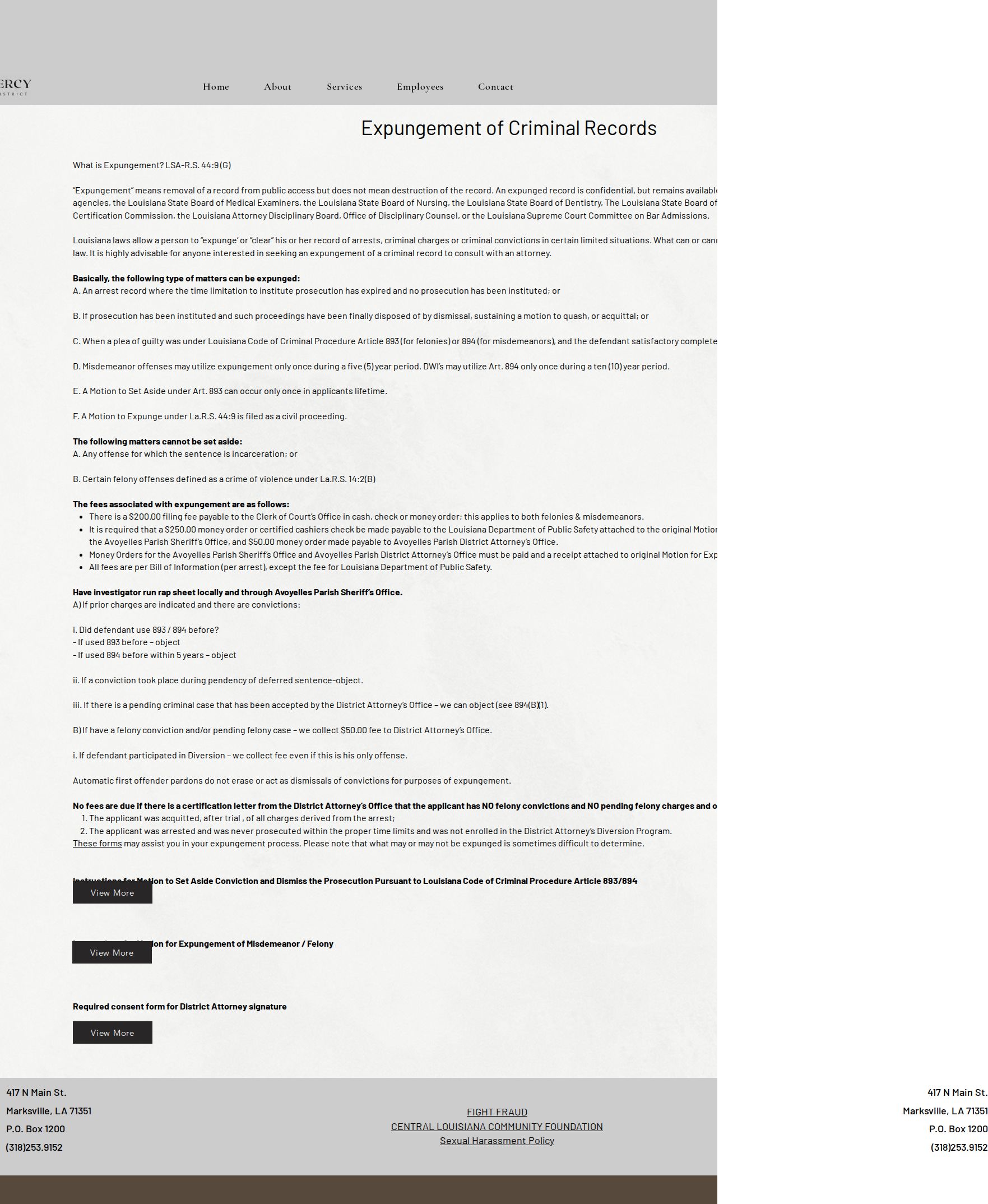
That process changes public access after judicial action. It does not prove that no custody occurred, and stale third-party material should not be treated as an official current record.
Find Avoyelles Parish Released Inmates
Start with the custody type, then search the matching authority. A recent local arrest points to APSO and DC-1 or DC-3. A Louisiana felony sentence points to DPS&C even when the person was housed in a parish facility. Federal prison history belongs to the Bureau of Prisons. Immigration detention belongs to ICE. The court file explains the legal order but does not replace the facility timestamp.
- Search the Avoyelles LAVNS roster and statewide Louisiana VINELink with exact names, spelling variants, and a known ID.
- Call DC-1 for a recent male booking or DC-3 for a recent female booking. Ask whether the event was release or transfer.
- For a state sentence, check statewide LAVNS and contact DPS&C for time computation or historical discharge fields.
- Ask the proper court for bond, dismissal, sentence, credit, probation, or revocation minutes.
- Use a narrow APSO record request when the live system cannot show past custody.
- Use BOP or ICE only when the known case or transfer points to that jurisdiction.
The complete named-person path stays on the home page. For alert registration after a correct match, use the Avoyelles Parish VINELink release check.
Avoyelles Roster and Release Status
The live Avoyelles LAVNS page identifies itself as the sheriff’s jail roster and describes incarcerated people. Its top-level fields include name, date of birth, race, gender, and arrest date. Alphabetical filters, a Show All control, a timestamp, and notification icons help with current custody. No official recent-release or archive selector was found as of July 20, 2026.
Observed timestamps fell near half-hour boundaries, suggesting a roughly 30-minute local refresh, but APSO does not promise that interval. DPS&C separately says statewide LAVNS information updates every 24 hours. Neither observation establishes how long a released record remains visible. The Released Last 24 Hours page therefore uses a records-request fallback rather than presenting the roster as a release feed.
Avoyelles Released Inmate State Search
The DPS&C inmate information page sends users to Louisiana LAVNS/VINELink. It documents searches by location, name, and ID or case number and says the public information updates every 24 hours. The dynamic display should be read exactly. A facility indicates reported custody. A released, out-of-custody, discharged, parole, or other status must not be silently converted into a different term.
| Search input | How it helps |
|---|---|
| State and location | Narrows Louisiana parish or state custody sources |
| Name | Starts a person search; try lawful spelling variants |
| ID or case number | Reduces confusion between namesakes |
| Agency and facility | Separates APSO custody from DPS&C custody |
| Status and date labels | Must be copied as displayed and checked with the custodian |
The official source also shows how DPS&C describes the locator and update cycle.

This statewide channel is the right starting point for Raymond Laborde and other state sentences, not proof of an APSO jail release.
Avoyelles Release Records and Court Minutes
The 12th Judicial District record can explain bond, dismissal, sentencing, time-served credit, and probation. APSO still controls the physical DC-1 or DC-3 release event. Pair the Clerk’s minute with the facility timestamp. One source shows legal authority; the other shows when and how parish custody ended.
Avoyelles has a crucial access quirk. The Clerk’s Cott eSearch login states that criminal information is not available through that paid portal. Contact the Clerk at 312 North Main Street, Marksville, LA 71351, by calling 318-253-7523 during listed weekday hours. Some ordinance, traffic, and misdemeanor matters can instead sit with Bunkie City Court or Marksville City Court, so first identify which court issued the order.
The official eSearch warning documents the exclusion.
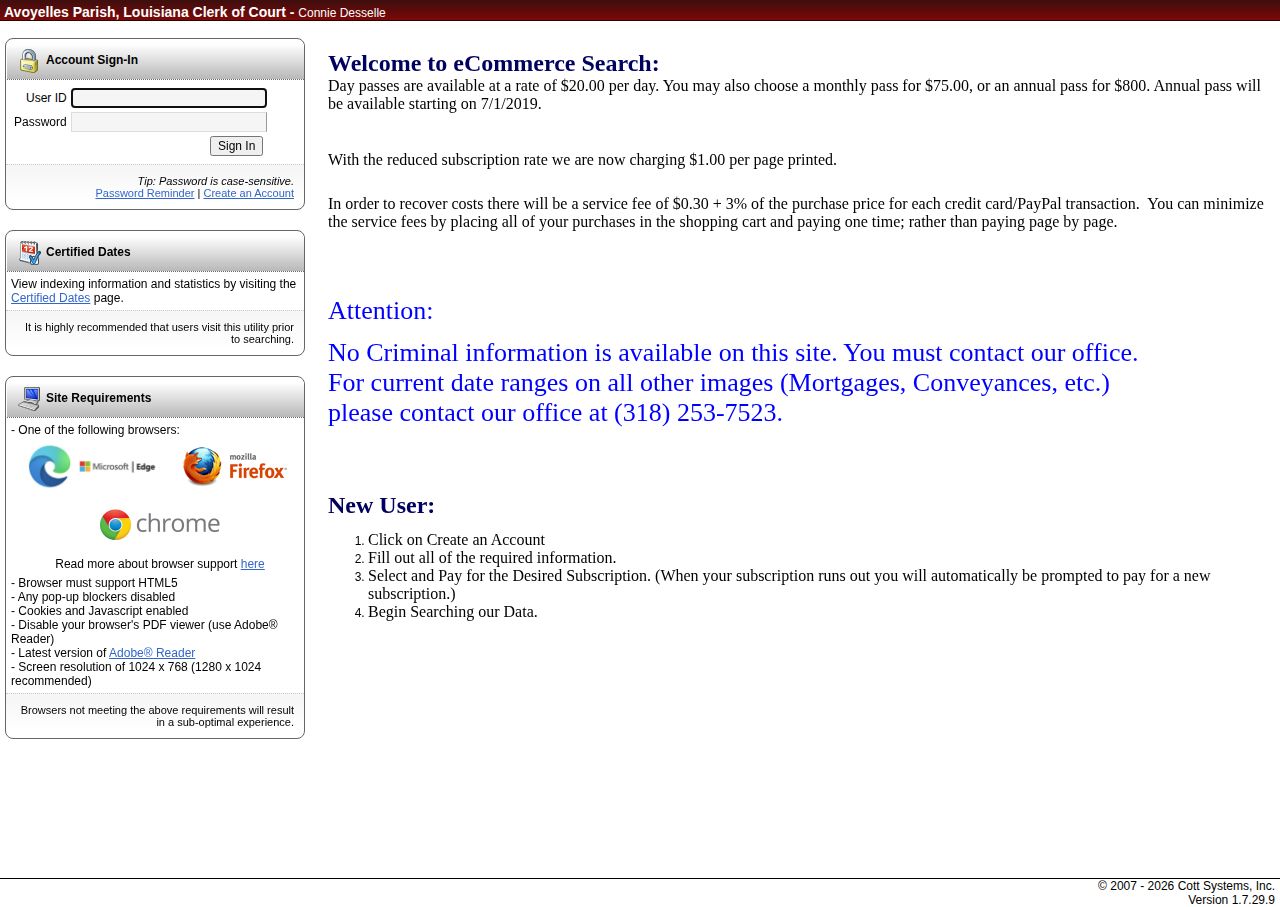
Checking that warning before buying access avoids paying for a portal that does not contain the criminal disposition sought.
Avoyelles Programs Are Not Release
APSO says its detention operations offer educational classes and a transitional work program for qualifying trustees. Participation remains custody. The separately listed Avoyelles Women’s Transitional Work Program also allows community work movement without ending correctional control. A person seen outside a secure building for approved work has not necessarily completed the program or sentence.
Confirm a program discharge with APSO or DPS&C. Ask for the completion or release event, not merely the person’s work location. This distinction is especially important in Cottonport, where the women’s program, DC-3, and Raymond Laborde serve different roles.
Avoyelles Release Facility Identity
Avoyelles Parish has an unusual custody map. DC-1 is the male parish detention center in Marksville. DC-3 is the female parish detention center in Cottonport. Raymond Laborde is a DPS&C state prison formerly called Avoyelles Correctional Center. The Avoyelles Women’s Transitional Work Program is a separate directory entry near the women’s site. “Cottonport jail” is therefore too vague for a reliable search or request.
The APSO corrections page identifies the two parish detention centers.

Use the complete name and correct custodian each time. DC-3 and Raymond Laborde share Cottonport geography but do not share release records.
The state directory adds the Avoyelles Women’s Transitional Work Program as its own entry. That listing matters because work movement can look like freedom to an observer while the participant remains in correctional custody. A release request should name the program, not just DC-3, and ask whether the person completed or left the program under a discharge, transfer, or other recorded event.
Getting Home After Avoyelles Release
Raymond Laborde’s official page says the closest named public transportation service is Greyhound in Alexandria, about thirty miles from the Cottonport prison. The page does not promise a ride from the prison to that station. Confirm the actual date, pickup rules, meeting point, and transportation plan before travel.
No official APSO source found a public release hour, exit door, family waiting point, property-return process, or shuttle for DC-1 or DC-3. Call the correct site and avoid blocking an entrance. A projected release date can change during final checks, so travel plans should rest on direct facility confirmation.
Avoyelles Release Search by Custody
Each public system answers a limited question. Use the row that matches the known custody, then corroborate a time-sensitive result with the source agency.
| System | Best use | Key limit |
|---|---|---|
| Avoyelles LAVNS roster | Current DC-1 or DC-3 custody | Not a release archive |
| APSO release record | Actual parish release or transfer event | Must be requested when not posted |
| Louisiana LAVNS/DPS&C | State custody, status, notifications | Public data may lag |
| Court minutes | Bond, dismissal, sentence, probation | May omit physical release time |
| BOP locator | Federal sentence status and release date | Does not rule out state, local, ICE, or supervision |
| ICE ODLS | Current or recent immigration detention | Not a full parish release history |
ICE reports that ODLS includes current detainees and people released from ICE custody within the last 60 days. An ICE detainer can ask APSO to give notice and hold a person briefly for possible pickup. The request itself does not prove that ICE took custody.
Avoyelles Parish Release Facilities
Match every search to one of these four entries. Parish detention releases are confirmed by APSO, state-prison release or discharge by DPS&C, and transitional-program completion by the operator or DPS&C as applicable.
- Avoyelles Parish Detention Center One (DC-1): male parish detention in Marksville.
- Avoyelles Parish Detention Center Three (DC-3): female parish detention in Cottonport.
- Raymond Laborde Correctional Center: state prison in Cottonport, formerly Avoyelles Correctional Center.
- Avoyelles Women’s Transitional Work Program: local work-release program whose community movement remains custody.
Use the full facility name in calls and written requests. That small step prevents many false matches and wrong-custodian responses.